The Goodfather: Part One
Sydney Morning Herald, November 21, 1997 (Aus)
Interviewed by Susan Chenery
Sent by Valerie
There are only two things that I am interested in writing about and that is God and love." Nick Cave bows his head and he prays. Or so it seems to me, as black hair brushes white cheek, and the thin curtain heaves and sighs in the window, and the bowed head remains intensely still as if seeking some kind of salvation. Have mercy Lord, deliver me from evil, deliver me from pain, deliver me from this interview.
And then, finally, as if from On High, He speaks. "I feel that God comes up with the ideas and I am just the person who jots them down. And I just want to write about love, love, love."
God and Love.
That would be a departure, then, from murder; from the spurting arterial blood, from the mutilation, from violent death and grotesque comedy and girls cuffed to beds with rags in their mouths and bullets in their heads, that have characterised his oeuvre. "I write very differently now to the way I used to write. Nearly all the songs I am writing now relate very strongly to me and the way I am in my life at the moment."
But he wasn't acting all that Godly when I arrived. "You're late," he had barked accusingly as if I was some kind of unwelcome irritation like genital herpes, say.
But now all of a sudden he seems to be in transcendence, seems to be radiating some kind of pure light. "I mean we are all on some kind of journey and in the way we go about it, I guess the journey is to learn how to love. I guess it 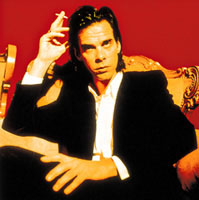 is moving towards a state of grace in some way. You are either able to do it or you are not. That is the true test of the artist in whether they can survive really. Oscar Wilde said something about you can't receive grace in a state of rebellion. I think that youthful music or music by young people is done in a state of rebellion. So consequently it is done in a state of disgrace and so it should be. That is what young music should be about. It should be disgraceful. At some point it is time to grow," he adds, glancing up sideways through long eyelashes, light streaming from lustrous blue eyes that sit at odds with the frown.
Nick Cave lights a cigarette and stares into his teacup as if the answer might be lurking in there. Dead roses sit in vases on the mantelpiece of his house in London's Notting Hill. A grand piano dominates the room. On the coffee table are books on theology, liturgical texts. Nick Cave is folded awkwardly onto the sofa, bent forward like a stick figure in a child's drawing, eyes downcast. There is clearly a lot going on in that strange jutting cliff face brow, just at the moment.
At 40 he has travelled all the extremes of his generation and further still, all the mountains and valleys and oceans and rivers of excess, of heroin addiction, substance abuse, of self-destruction and healing, sloughing and renewing, of searching for spirituality, for meaning. Of being lost and found and lost again. Of destroying to create.
"Our lives are a continuous kind of resurrection and crucifixion, that is what the journey of life is." And now he has arrived at a place of blinding love, it seems. It has always been there in his work, all of it, in all the 20 albums, in his book And The Ass Saw the Angel, in the hundreds of songs going back to his filthy gothic junkie anarchy in the narcotic netherworld punk movement; the biblical references, that violent old book the Old Testament, the shining love songs. Who could forget The Ship Song, that great song of a man committing to a woman, or Straight to You "this is the time of our great undoing/I am captured."
They were real, joyous love songs; but his love songs on his latest album The Boatman's Call are something else again. Pared down and raw. They are real pain.
"A love song can be angry, they can be very, very angry. I am interested in writing about things that really excite me, and love seems to be it. I don't fall in love every day. I don't fall in love very much, but when I do it is a very, very complete kind of thing and I invest an incredible amount of energy into it. Perhaps too much, perhaps that is why they don't last, or succeed."
For Nick Cave could not have uncomplicated love, not this difficult, tortured, intense, searching, genius man; murderer and lover at once. "I am always aware of the potential of pain when I fall in love. I can almost feel the pain on its way. But I wouldn't trade it in for anything. Pain is very much a part of it. At the moment in my life I am in love but the person I am in love with can't be with me or won't be with me, so I am in a state. I find myself spending a lot of time writing songs about this person and about this particular situation and I do that in order to be with that person. I find that song writings are like a long meditation upon a particular person and they are intense meditations. Consequently it feels like you are with that person, it is the next best thing, it allows me to be with that person for the time I am engaged with writing about that person."
Perhaps it gives him material and time to write without having to deal with the day-to-day hassle of another person's happiness.
"No," he says so tragically that we both laugh. "I would much prefer that she was here, I would trade the songs back to have her here. "
Photographs of Nick Cave's six-year-old son Luke in a school uniform sit at odds on his mantelpiece with the rest of his stuff, the pure love of a child. Many of the songs on the The Boatmans Call deal with the break up of his marriage to Luke's mother, the Brazilian Viviane Carneiro. "I am a crap husband, a crap lover and a crap son" he told a journalist last year. "But I am a great father." He lives in London now because his son lives here. "Where ever he goes I will go. It is a pure love. You learn a lot about yourself in the process of that. I feel all I have got to do is love him. It is very, very easy and natural."
As he talks I start to realize that Nick Cave is telling me something. Something important. He is talking about God. He has always been a darkly charismatic, if surly and impatient presence. He may become an evangelistic leader one day.
Even if he doesn't know it himself yet.
The Sydney Morning Herald Friday 21 November, 1997. This material is
subject to copyright and any unauthorised use, copying or mirroring is prohibited.
|

